
Welcome to another edition of Capital Markets Pulse, a monthly newsletter from the Center for Audit Quality that brings you insights, resources, and tools on the latest issues impacting the capital markets.
As we close out 2025, the profession finds itself at a pivotal moment. This year has made it clear that rapid technological change and shifting regulations are no longer just future concepts; they are the reality we operate in every day. Amidst these dynamics, our profession remains the anchor of trust in capital markets.
Looking ahead to 2026, the path forward is coming into focus. From the strategic conversations at the Axios BFD Summit to the “back-to-basics” focus emerging from the SEC, the message is clear: compliance is just the starting point. Investors and other stakeholders are increasingly looking for elevated communication, proactive fraud deterrence, and greater transparency on material concerns.
In this edition, we’ll dive into the shifts in corporate reporting revealed by our latest 10-K analysis, discuss the findings from our Audit Committees Transparency Barometer, and explore the landscape ahead with new leadership at the PCAOB.
Read on for the latest updates and insights from the profession.
Please note that these perspectives are my own. If this email was forwarded to you, subscribe here so that you never miss a public company auditing update.

Profession Updates
CAQ Attends the AICPA Conference on Current SEC and PCAOB Developments
In December, my colleagues and I attended the annual AICPA Conference on Current SEC and PCAOB Developments, where I took the stage for separate conversations with SEC Chairman Paul Atkins and SEC Chief Accountant Kurt Hohl. In our conversation, SEC Chief Accountant Kurt Hohl talked about his perspective that financial reporting is fundamentally a communication activity that demands comprehensive disclosure, especially in a volatile macroeconomic environment. As new rules on cybersecurity, clawbacks, and pay-versus-performance come into play, the profession must weave compliance into a cohesive, strategic narrative.
The dialogue underscored that a strong tone at the top and unwavering independence are the bedrock of trust and further stressed the importance of robust audit committee oversight. Regulators also emphasized that professional care must apply to every primary financial statement, specifically the Statement of Cash Flows. The message is clear: even as new disclosure areas emerge, we cannot lose sight of the fundamentals.
Audit quality also delivers investor protection. In my conversation with Chairman Paul Atkins, we discussed a “back-to-basics” directive for the profession, placing integrity, objectivity, and professional skepticism at the forefront. This guidance makes clear that, despite market disruption, core audit values are non-negotiable.
Chairman Atkins further indicated a strategic focus on market efficiency, signaling an intent to remove undue regulatory burdens to bolster the public market. Similarly, Chief Accountant Hohl outlined the Office of the Chief Accountant’s (OCA)’s priorities, centering on robust oversight of the FASB and PCAOB, and the governance of international standards.
Later in the day, the CAQ’s Vice President, Professional Practice and Anti-Fraud Initiatives, Dennis McGowan moderated a session discussing efforts to strengthen financial fraud prevention across the reporting ecosystem through the Anti-Fraud Collaboration. The panel explored the AFC’s four core priorities: understanding emerging fraud risks through benchmarking research, building strong ethical cultures that defend against the fraud triangle, maintaining professional skepticism despite barriers like time pressure and complacency, and leveraging technology including AI and generative AI to detect and prevent fraud.
Attendees gained valuable insights into the AFC’s thought leadership and resources available to help organizations enhance their anti-fraud programs. Visit the AFC’s website to leverage these tools for your own oversight and fraud prevention work.
PCAOB Leadership Change: Positioning for Future Oversight
Early this month, the PCAOB announced the planned departure of Board Member Christina Ho in January 2026. PCAOB Acting Chair George R. Botic thanked Board Member Ho, as she has “championed innovation as a driver of improvement in audit quality” during her tenure.
This transition represents a strategic moment as the SEC considers nominees who will shape the future direction of audit oversight, particularly in regard to the two CPA positions on the Board of 5 Members. Board Member Ho’s departure underscores the need for a Board committed to fostering resilience, promoting innovation, and upholding common-sense regulation. We remain ready to work with the PCAOB to ensure the public interest is prioritized throughout this process.
CAQ Updates
Axios BFD: Driving Strategic Dialogue
At the Axios BFD Summit, I had the pleasure of highlighting the essential value that the public company auditor brings to the capital markets. To explain why assurance matters, especially when markets are moving quickly, I shared one of my favorite, simple, metaphors.
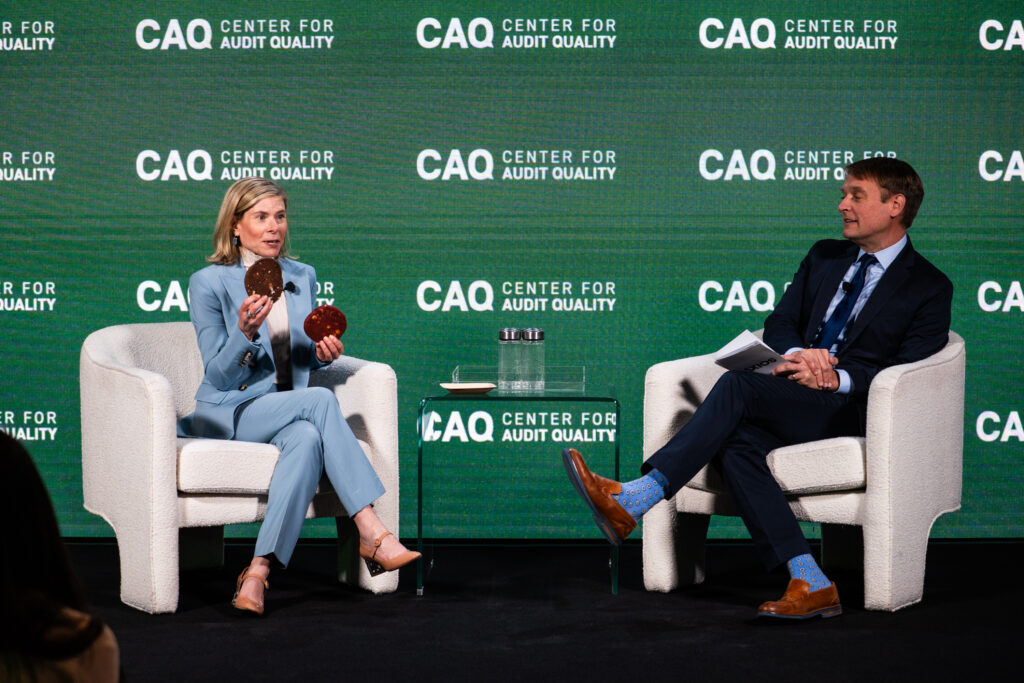
When you’re eating a cookie that someone else made, you want to know the ingredients used were high quality and safe, but you also want to know the instructions were followed, the steps were tested, and someone checked that it all came together the way it was supposed to. That oversight is what turns a list of ingredients into something you can eat with confidence.
The same is true in our capital markets. Companies prepare their ingredients, in this case their financial statements, for reporting, but auditors provide the independent verification that gives investors something looked at by a third set of eyes to rely on, even when the environment feels hectic or uncertain.
Check out my conversation with Nicholas Johnston.
The Rise of AI in 10-Ks: A Strategic Shift in Reporting
The growth and use of advanced artificial intelligence and digital assets is reshaping the financial reporting trends and creating new blind spots.
In our recent 10-K analysis, the CAQ found that 90% of S&P 500 companies addressed AI in their 2024 10-Ks, marking a nearly 25% increase year-over-year. This rapid growth confirms that transparency in AI is a significant focus for management and investors, with disclosures appearing most frequently in the Risk Factors (Item 1A) and Business (Item 1) sections of the 10-K.
These findings highlight a significant challenge: much of the disclosure regarding AI, digital assets, and sustainability resides outside the audited financial statements. This distinction offers the audit profession a clear opportunity to reaffirm its value. As investors place greater reliance on this broader set of information, the profession must apply the same rigor of assurance to these emerging areas as it does to traditional financial data. Meeting this demand requires auditors to continue upskilling and leveraging technology to support high-quality disclosures in this evolving landscape.
My colleague, Desiré Carroll, Senior Director of Professional Practice, shares additional observations in her latest blog, “AI, Digital Assets, and Sustainability: What Form 10-Ks Tell Us About Reporting Trends.” I encourage you to take a look.
Transparency Barometer: Mandating Oversight Clarity
The latest Audit Committee Transparency Barometer validates investor demand for proactive corporate governance. The report underscores that while a board skills matrix disclosure reached 90% among S&P 500 companies, a clear plateau is evident in disclosures regarding the audit committee’s annual evaluation of the external auditor, which remains at 50%.
This stagnation represents an opportunity for audit committees to demonstrate how their oversight is evolving in response to challenges like cybersecurity and AI. Audit committees perform a key role in our capital markets, from overseeing the external auditor to monitoring company financial reporting and internal controls and serving as an effective check on management.
Meaningful, investor-focused disclosure is one of the most powerful tools audit committees have to tell their story and demonstrate this important role. Each proxy season presents an important opportunity for audit committees to more clearly communicate how they oversee risk and uphold audit quality, strengthening investor confidence in a rapidly changing environment.
As the landscape continues to evolve in 2026 and beyond, we encourage committees to move beyond formulaic language and enhance transparency to reassure stakeholders of the diligence applied to selecting and overseeing the external auditor, thereby strengthening trust and confidence in the financial ecosystem.
Fraud Forum: Reaffirming Investor Protection
During this year’s Fraud Awareness Week, I had the pleasure of participating and representing the CAQ at the Anti-Fraud Collaboration’s Fraud Forum. The event brought together members of the financial reporting ecosystem. Together, we discussed the changes in a dynamic fraud risk landscape, focused on existing roles and responsibilities of all members, and shared key considerations for strengthening fraud deterrence and detection practices.
I encourage you to explore additional insights as we continue to stay vigilant against fraud, especially as new advanced technologies pose new risks to the profession.
Accounting+/Talent Update
Department of Education Declassifies Accounting as a Profession Classification
In response to the Department of Education’s declassification of accounting as a professional degree program, the AICPA and state CPA societies are driving a critical effort to reverse this decision. As we look to invest in the talent pipeline, properly defining the educational rigor required for our profession is essential. We will continue to monitor and update as developments occur.
Thank You for an Incredible Year
I want to express my deepest gratitude for the hard work and dedication from all members of the reporting profession. Your efforts have strengthened our profession’s voice as we strive to protect the capital markets. We have built tremendous momentum this year, and I am excited to channel that energy into more impact in 2026. I hope you all find time to rest and recharge—you have earned it!
Julie Bell Lindsay
Chief Executive Officer, CAQ