What the 2025 Institutional Investor Survey Says About Trust
Investor confidence in the audit is a result of a specific set of measurable conditions: independence, rigor, oversight, and comparability.
The CAQ’s 2025 Institutional Investor Survey emphasizes this landscape. While 91% of investors trust the accuracy of audited financial statements, today, they are evaluating whether the same rigor will be applied to assurance in emerging domains of corporate disclosures like AI and data privacy. For a profession that understands the importance of trust in our capital markets, these considerations point to where the next decade of credibility will be won or lost.
Here are the top three areas that the profession should consider to continue securing investor confidence.
1. 35% of institutional investors express concern about auditor independence
Independence is one of the profession’s most valuable assets, yet a meaningful share of investors is not fully confident it’s being protected.
Investors regularly consider the audit firm’s relationship to management and the company when evaluating the value and reliability of disclosures, and they expect stringent independence rules to be in place to validate the credibility of this information.
Deliberate policy choices made through decades of public debate and rulemaking enacted the independence rules we have today. The landmark Sarbanes-Oxley Act enhanced internal controls and elevated the role of the audit committee to hire, manage, and compensate the external auditor rather than company management. These requirements preserve objectivity and strengthen investor confidence in assurance.
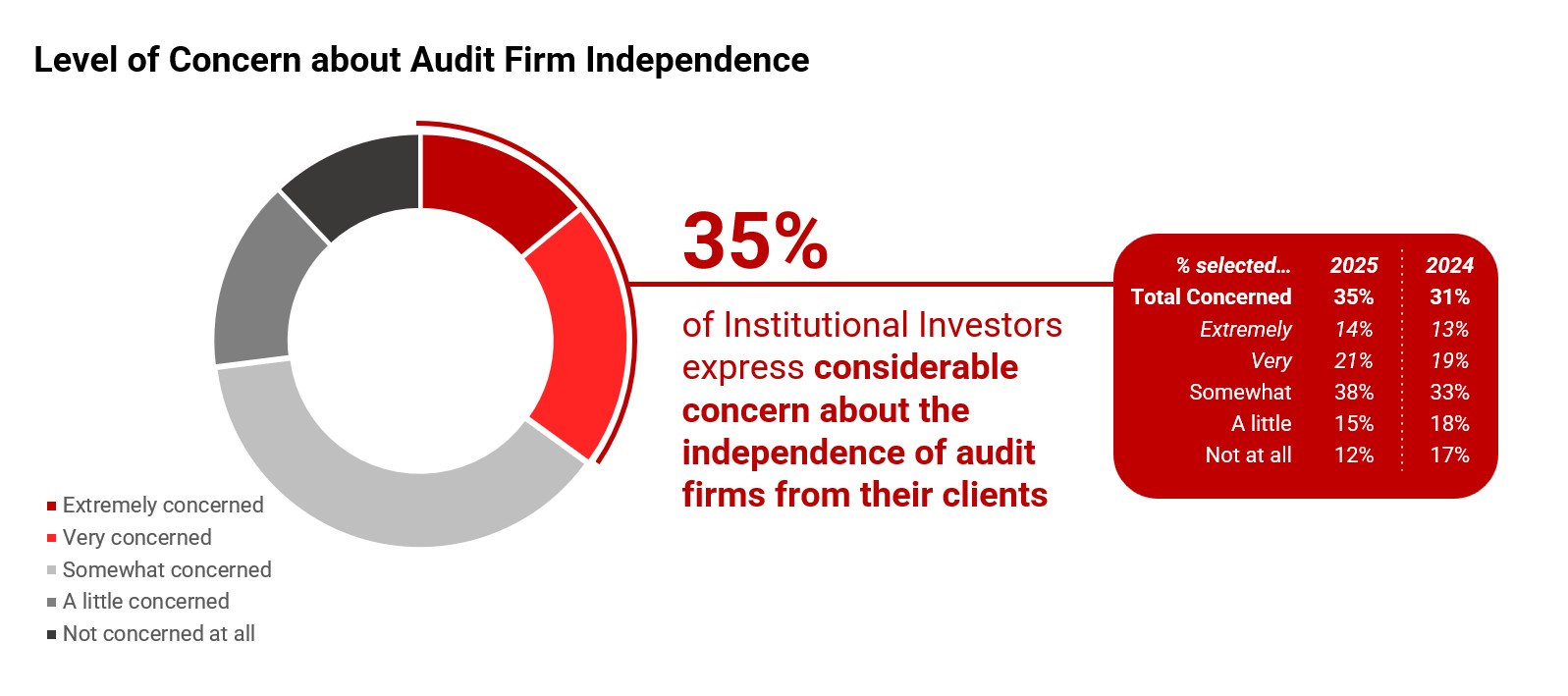
Despite these safeguards, 35% of respondents in our investor survey are concerned about the independence of audit firms from company management. The profession must continue to emphasize its independence and objectivity as we move into new assurance domains while navigating the current climate of skepticism in institutions. Independence is not a compliance checkbox; it is a rigorous discipline that investors can rely on to make decisions that shape capital allocation.
Deliberate policy choices made through decades of public debate and rulemaking enacted the independence rules we have today.
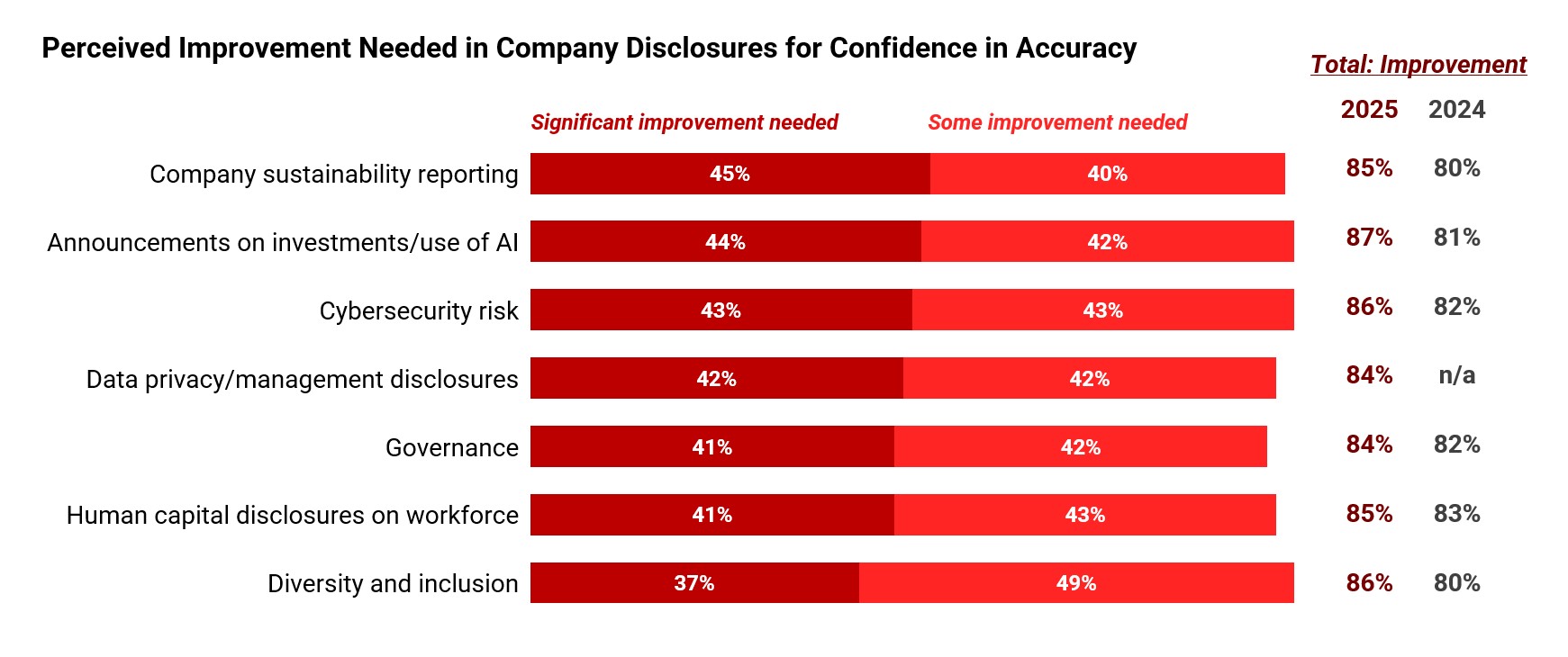
2. Over 85% of investors want to see improvements in AI, cybersecurity, and other corporate disclosures.
Investor appetite for consistent, comparable corporate disclosures outside of the financial statements continues to grow. Public companies are increasingly reporting on topics like AI usage and cybersecurity risk, yet our survey found that around 85% of investors believe improvements in these areas are still needed.
Other corporate information plays a critical role in helping investors form a holistic view of a company’s operations, risks, and strategy. Auditors are steeped in the values that bring credibility and transparency to decision-useful information, and the profession has a history of bringing trust to emerging reporting areas.
By engaging public company auditors on other corporate disclosures, public companies gain the same rigor, independence, and expertise that build investor trust in financial reporting.
Investor appetite for consistent, comparable corporate disclosures outside of the financial statements continues to grow.
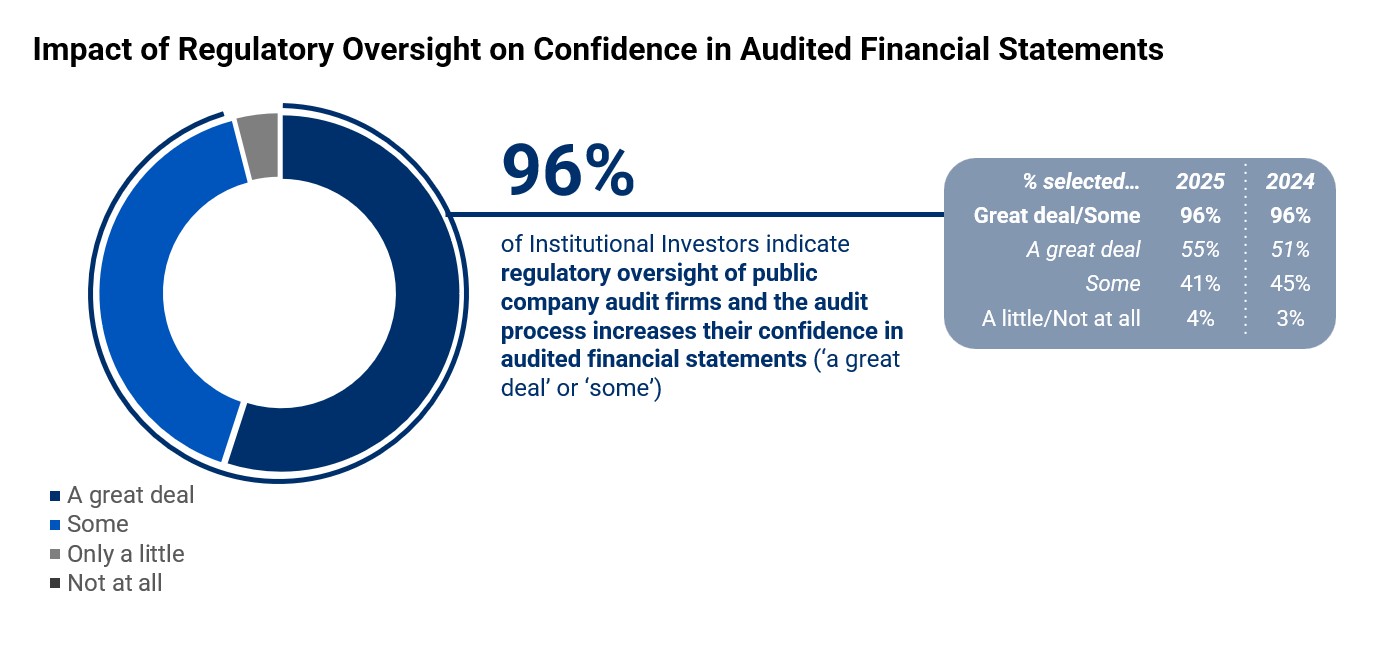
3. Over 95% of investors report that regulatory oversight increases their confidence in audits.
Support for oversight is nearly universal among institutional investors, and investors outline specific expectations about what oversight should accomplish. Over 95% of respondents draw a direct line between regulatory oversight and audit confidence; nearly one-third also believe the current regulatory burden on auditors is too high. Investors want a framework that effectively enhances audit quality, not compliance volume for its own sake.
As the profession leads across expanding landscapes like cybersecurity and AI governance, regulatory frameworks that evolve alongside assurance will keep investor confidence stable.
The profession has an opportunity to help shape what those changes will look like. Strong engagement with policymakers and regulators now will ensure expanded assurance contributes to the trust that underpins well-functioning capital markets.
Support for oversight is nearly universal among institutional investors, and investors outline specific expectations about what oversight should accomplish.
What This Means for the Profession
Existing independence safeguards, expanded areas of assurance, and extended regulatory frameworks are top of mind for investors, and the profession is well equipped to address these needs and continue providing trust solutions to capital markets. The path forward requires a vocal commitment to objectivity, transparency into how the scope of assurance is changing, and engagement with regulators to build standards that support the gold standard of audit quality the U.S. is known for.
Read the full Institutional Investor Survey for more insights into how investors view the audit.